In the anthropology of human relationships, few artifacts possess the enduring resonance of the ring. A simple band of metal, continuous and unbroken, has served for millennia as the ultimate signifier of loyalty, ownership, status, and love. Yet, within the modern bridal industry and Western social custom, this singular symbol has bifurcated into two distinct entities: the engagement ring and the wedding ring. While they are frequently worn on the same finger and purchased by the same couple, these two objects occupy vastly different spaces in the cultural, historical, and economic landscape.
The distinction between the two is not merely semantic; it is structural. The engagement ring is a symbol of intent—a flashy, often high-value declaration of a promise to marry. It is the artifact of the proposal, historically rooted in betrothal contracts and revolutionized by twentieth-century marketing. In contrast, the wedding ring is the symbol of fulfillment—a typically more understated band exchanged during the ceremony to seal the vows. It is the artifact of the marriage itself, grounded in ancient beliefs about anatomy and eternity.
This report provides a comprehensive, expert-level examination of these two pillars of bridal jewelry. By synthesizing historical records, economic data from 2023-2024, and sociological trends, we aim to demystify the traditions for the prospective buyer. We will explore the journey from the iron bands of Ancient Rome to the lab-grown diamond revolution of the modern era, analyzing how costs, designs, and etiquettes have evolved. We will also address the practicalities of timing and budget, stripping away industry jargon to provide a clear guide to the circles that bind us.
Before dissecting the specific lineage and economics of each ring, it is essential to establish the fundamental differences that separate them. Confusion often arises because the two rings are increasingly sold as sets or worn simultaneously. However, their roles are distinct.
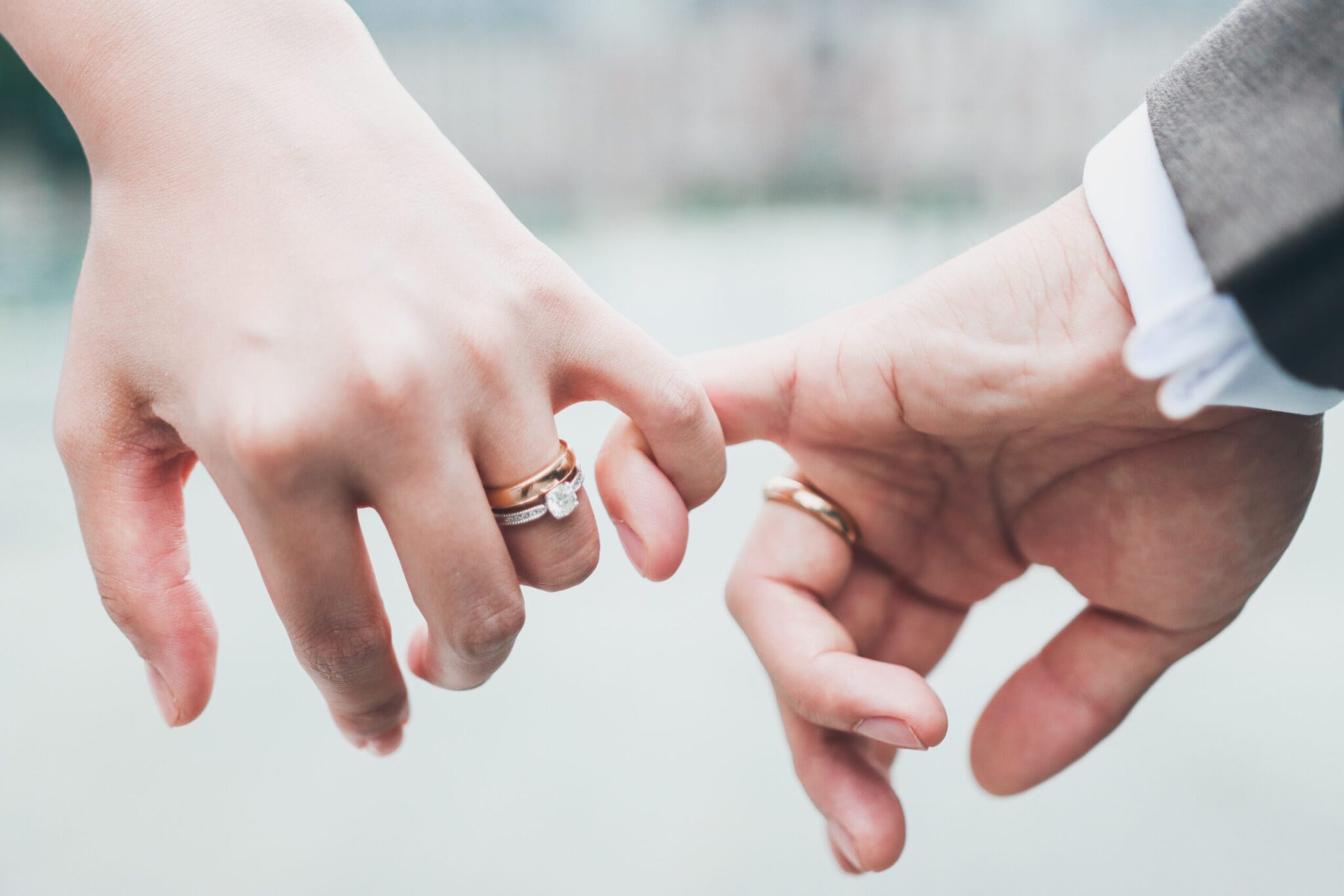
The engagement ring is the “question.” It is presented during the proposal, a period of high romance and anticipation. Its design is typically extroverted, built around a central gemstone that catches the light and the eye. It signifies that a person is “spoken for”.
The wedding ring is the “answer.” It is exchanged during the wedding ceremony, a moment of solemn contract and public witness. Its design is typically introverted—a continuous band with no beginning and no end, representing the eternal nature of the bond. It signifies that the union is legally and spiritually complete.
Engagement Rings vs Wedding Ring Differences Overview
The following comparison matrix provides a high-level summary of these key distinctions across symbolism, timing, design, and cost, serving as a roadmap for the detailed analysis that follows.
| Feature | Engagement Ring | Wedding Ring |
|---|---|---|
| Primary Symbolism | Promise of marriage, intent, and commitment. | Eternal love, unity, and fulfillment of vows. |
| Timing of Exchange | Presented during the marriage proposal. | Exchanged during the wedding ceremony. |
| Typical Design | Elaborate; often features a prominent center gemstone (e.g., diamond). | Simpler; plain metal band or band with small accent stones. |
| Average Cost (2023/24) | ~$5,500 (National Average) | ~$600 (Men) – $1,200 (Women) |
| Wear Position | Worn alone during engagement; usually stacked on top after marriage. | Placed first on the finger to sit closest to the heart. |
| Historical Origin | Ancient Rome (Iron rings); 15th Century (Diamond tradition). | Ancient Egypt (Circle symbolizing eternity). |
The interaction between these two rings is also a matter of evolving etiquette. While they represent different stages of the relationship—the engagement ring for the promise, the wedding ring for the fulfillment—modern couples often view them as a cohesive unit. The “bridal set,” where the two rings are designed to interlock or complement each other perfectly, has become a staple of jewelry design, reinforcing the idea that while the rings have different meanings, they ultimately tell two halves of the same story.
The Engagement Ring: Definition and Purpose: The Symbol of Intent
An engagement ring is a tangible token of betrothal. It serves a dual purpose: it is a private pledge between two people that a marriage will occur, and it is a public signal to the wider community that the wearer is no longer available for courtship. Historically, this public signaling was crucial in eras where marriage was as much a dynastic or economic alliance as a romantic one.
The ring is traditionally worn on the fourth finger of the left hand, a custom derived from the belief in the vena amoris (discussed in depth in the Wedding Ring section). While the engagement period is a transitional phase—a time of planning and waiting—the ring itself is designed to be permanent, worn throughout the engagement and typically for the duration of the marriage, stacked alongside the wedding band.
Historical Evolution: From Iron Contracts to Diamond Dreams
The history of the engagement ring is a fascinating trajectory that moves from the legalistic to the romantic, and finally to the commercial.
Ancient Origins: The Roman Contract
The lineage of the engagement ring does not begin with diamonds or precious metals, but with iron. In Ancient Rome, the anulus pronubus was a plain iron hoop given to a bride-to-be. This was not merely a romantic gesture; it was a symbol of strength and permanence, reflecting the binding nature of the marriage contract. It also carried connotations of ownership. Roman brides would often receive two rings: one of iron to be worn at home while attending to domestic duties, and one of gold to be worn in public as a display of her husband’s social standing and wealth.
This duality highlights the early function of the ring: it was a marker of a transaction between families as much as a bond between individuals. By the 2nd century BCE, gold became the standard for those who could afford it, but the symbolism of the “contract” remained. In 850 AD, Pope Nicholas I gave religious weight to this tradition by declaring the engagement ring a formal sign of marital intent. Crucially, he decreed that the ring should represent a financial sacrifice for the groom, cementing the idea that the ring’s value was a measure of commitment.
1477: The Archduke and the Diamond
The specific association between engagement and diamonds—now considered the default—has a precise origin point in European history. In 1477, Archduke Maximilian of Austria was betrothed to Mary of Burgundy. To seal the union, he commissioned a ring set with thin, flat diamonds arranged in the shape of the letter “M.” This is widely cited as the first recorded diamond engagement ring.
Maximilian’s gesture sparked a trend among the European aristocracy. For centuries, however, diamond rings remained the exclusive province of the ultra-wealthy. Diamonds were rare, sourced primarily from India and later Brazil, and were inaccessible to the common classes. Through the Renaissance and Victorian eras, engagement rings were just as likely to feature colored gemstones like sapphires, rubies, or emeralds, or to be “posy rings” inscribed with poetry rather than set with stones.
Manufacturing Tradition
The ubiquitous diamond engagement ring of today is largely a product of the 20th century, driven by one of the most successful marketing campaigns in history. In the late 1930s, the diamond market was in crisis. Prices had collapsed during the Great Depression, and diamonds were falling out of fashion with younger generations in the United States. De Beers, the cartel that controlled the majority of the world’s diamond supply, hired the advertising agency N.W. Ayer to reverse this trend.
The campaign, launched in 1939 and solidified in 1947 with the slogan “A Diamond is Forever,” fundamentally rewired the cultural psychology of marriage.
- Psychological Link: The campaign successfully linked the durability of the diamond (the hardest natural substance) with the durability of marriage. If a marriage is forever, the ring must be too. This had a secondary economic benefit for De Beers: by positioning the diamond as an heirloom that signifies eternal love, they discouraged consumers from reselling their diamonds, thereby preventing a secondary market that could undercut prices.
- The Salary Rule: De Beers also invented the etiquette regarding how much to spend. In the 1930s, marketing materials suggested one month’s salary. By the 1980s, as they sought to move larger and more expensive stones, they adjusted this “rule” to two months’ salary (and even three months in Japan). This was not a tradition rooted in history; it was an anchoring tactic rooted in sales targets. Yet, it became accepted wisdom.
The impact was total. Before WWII, only 10% of engagement rings in the US contained a diamond. By the end of the century, the diamond solitaire was the standard.
The Economics of Engagement: Costs and Trends
The engagement ring is almost invariably the most expensive component of bridal jewelry. Its value is concentrated in the center stone, making it a significant financial undertaking for most couples.
Average Costs and Regional Variances
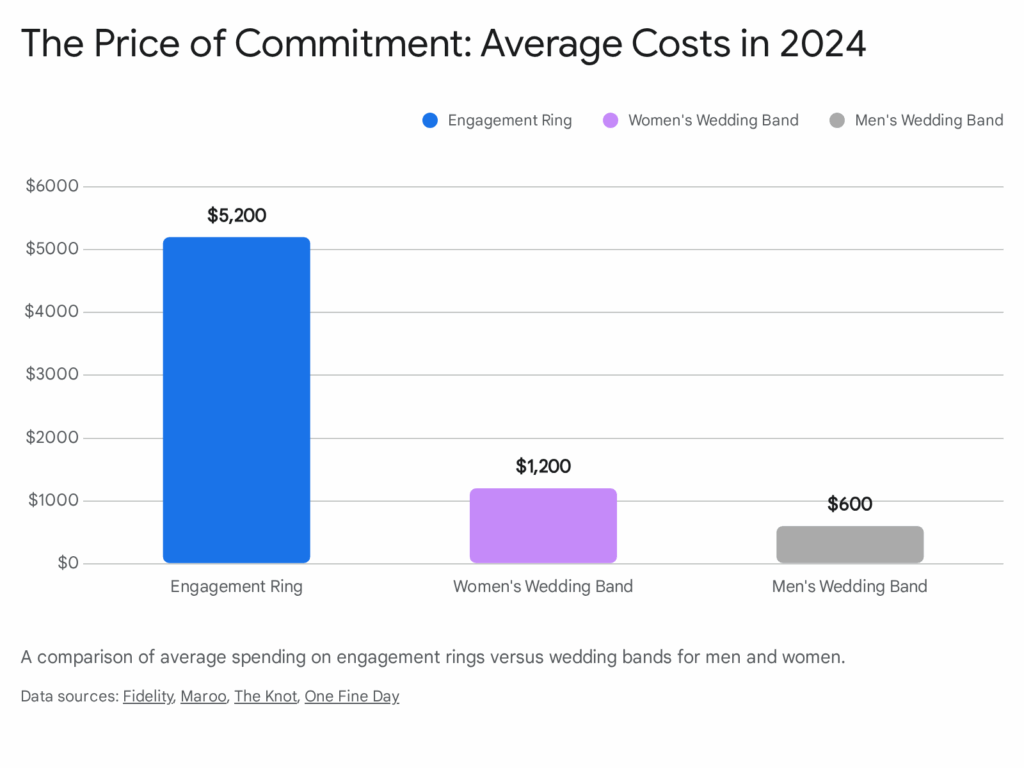
As of 2024, the national average cost of an engagement ring in the United States is approximately $5,500. However, this figure requires nuance. The “average” is often skewed upward by a small percentage of very high-value purchases.
- The Median Reality: A more representative look at spending shows that about one-third of couples spend between $1,000 and $4,000. This suggests that while the $5,500 figure is accurate as a mean, many couples are finding beautiful options well below that threshold.
- Geography Matters: Where a couple lives significantly impacts what they spend. Couples in the Mid-Atlantic region (New York, New Jersey, Pennsylvania) spend the most, averaging around $6,900. In contrast, couples in the Midwest spend the least, averaging approximately $4,900. This correlates with the general cost of living and average incomes in these regions.
- The “Rule” is Dead: Financial experts and etiquette coaches now largely agree that the “two months’ salary” rule is obsolete. The modern consensus is that one should spend what they can afford without jeopardizing their financial future. In fact, one in three proposers still incurs debt to buy the ring, a practice cautioned against by financial advisors.
The 4 Cs: Determinants of Value
The price of the ring is dictated almost entirely by the quality of the center diamond, assessed by the “4 Cs”:
- Carat: The weight of the diamond. Larger stones are exponentially more rare and thus more expensive.
- Cut: How well the diamond is faceted to reflect light. A better cut equals more sparkle and a higher price.
- Color: The lack of color. The most expensive diamonds are colorless (D-F grade), while those with yellow tints are less valuable (unless they are “fancy” vivid colors).
- Clarity: The absence of internal flaws (inclusions). Flawless diamonds are incredibly rare and priced accordingly.
The Lab-Grown Trend
The most significant disruption to the engagement ring market in decades is the rise of lab-grown diamonds. These stones are not “fakes” like cubic zirconia; they are chemically, physically, and optically identical to mined diamonds. The only difference is their origin.
- Cost Efficiency: Lab-grown diamonds typically cost 30% to 50% less than natural diamonds of the same quality. This allows buyers to purchase larger, higher-quality stones for a fraction of the price of a mined equivalent.
- Market Shift: The adoption rate is exploding. In 2019, lab-grown diamonds were a niche product. By 2024, over 50% of all engagement rings sold featured a lab-grown stone. This shift is driving down the average cost of engagement rings (from $6,000 in 2021 to $5,500 in 2023) while simultaneously driving up the average size of the stone. The average center stone size has grown from 1.5 carats in 2021 to 1.7 carats in 2024, as couples use the savings from lab-grown tech to “upsize” their choice.
Timing: When to Ask and When to Buy
The purchase of an engagement ring is rarely an impulse buy. It follows a predictable seasonal and logistical rhythm.
Engagement Season
While couples get engaged throughout the year, there is a distinct “Engagement Season” in the United States that runs from Thanksgiving (late November) through Valentine’s Day (mid-February).
- December Dominance: December is consistently the most popular month for proposals, accounting for roughly 20% of all engagements. The convergence of family gatherings, festive atmosphere, and time off work creates the ideal backdrop for the question. Christmas Day and New Year’s Eve are among the most popular individual days for proposals.
- Summer Spikes: While winter dominates, there are secondary spikes. July and August are also popular, driven by summer vacations and favorable weather for outdoor proposals.
The Buying Timeline
For the proposer, the clock starts ticking well before the knee hits the ground.
- Lead Time: The recommended lead time for purchasing an engagement ring is 2 to 3 months before the proposal. This is because many engagement rings are made to order. Even if buying a pre-set ring, sizing can take days or weeks. If commissioning a custom design, the process can take even longer—up to several months for design approval, casting, and setting.
- Research Phase: Statistics show that 50% of proposers begin researching rings 3 to 6 months in advance. This research phase is critical for understanding the partner’s style preferences (often by subtly checking their jewelry box or asking friends) and for financial planning.
The Wedding Ring– Definition and Purpose: The Seal of the Vow
If the engagement ring represents the promise, the wedding ring represents the fulfillment of that promise. It is the ring exchanged during the actual marriage ceremony, accompanied by the recitation of vows. While the engagement ring is a status symbol of “betrothal,” the wedding ring is the universal signifier of “marriage”.
Physically, the wedding ring is distinct in its simplicity. It is typically a continuous metal band, uniform in width and design all the way around. This circularity is key to its symbolism: a circle has no beginning and no end, representing the eternal nature of the union. Unlike the engagement ring, which is designed to be taken off for safe-keeping during strenuous activity, the wedding ring is often designed to be worn 24/7. It sits lower on the finger and lacks the high-profile prongs that can snag on clothing, making it a practical, everyday token of the commitment.
Historical Evolution: From Veins to World Wars
The wedding ring has an ancient lineage that predates the diamond engagement ring by thousands of years, rooted in physiology and global conflict.
Ancient Egypt and the Vena Amoris
The tradition of the wedding band traces back to Ancient Egypt, nearly 5,000 years ago. The Egyptians were the first to use the circle as a symbol of eternity. They fashioned rings from braided reeds, hemp, or leather. While these materials were not durable, the symbolism was potent.
The custom of wearing the ring on the fourth finger of the left hand also stems from this era. Egyptian anatomists (and later Greeks and Romans) believed that a specific vein, the vena amoris or “Vein of Love,” ran directly from this finger to the heart. Placing the ring on this finger was seen as establishing a direct physical connection to the center of emotion. While modern science has disproven the existence of such a singular vein, the tradition remains the standard in Western cultures.
The Gimmel and the Church
In the 16th and 17th centuries, the “Gimmel ring” became popular. This was a complex ring consisting of two or three interlocking bands. During the engagement, the man and woman would each wear one part of the ring. At the wedding ceremony, the parts would be reunited to form a single, complex ring worn by the bride, symbolizing the two lives becoming one. This highlights that historically, the distinction between engagement and wedding rings was sometimes fluid.
The Rise of the Male Wedding Band
Perhaps the most significant shift in the history of the wedding ring is who wears it. For most of history, only the woman wore a wedding ring. It was a mark of her status as a wife. Men did not wear rings to signify marriage.
This changed dramatically during World War II. As millions of American and European men deployed overseas, facing indeterminate separations and the very real possibility of death, they began wearing wedding bands as a tangible connection to their wives and families back home. The ring became a sentimental lifeline. When the war ended, the custom stuck. The “double ring ceremony,” where both bride and groom exchange rings, became the standard in the post-war era. Today, it is rare for a groom to forego a wedding band, a tradition that is less than a century old in widespread practice.
The Economics of Wedding Rings
Compared to the engagement ring, the wedding band is a relatively minor expense. However, choices in metal and design can still impact the budget.
Average Costs
In 2024, the average cost of a wedding band shows a gender disparity driven by design complexity:
- Women’s Bands: The average cost is approximately $1,200. This is because women’s bands often feature “pavé” diamonds (small diamonds set closely together) or other gemstones to match the sparkle of the engagement ring. This adds to both the material and labor costs.
- Men’s Bands: The average cost is significantly lower, around $600. Men’s bands are typically simpler, often plain metal without gemstones. However, costs can rise if the groom chooses platinum (a dense, expensive metal) or a complex custom design.
Ring Material Choices
The choice of metal is the primary cost driver for wedding bands.
- Gold (Yellow, White, Rose): The traditional choice. 14k or 18k gold is durable and classic. White gold requires rhodium plating to maintain its silver color, which can wear off over time.
- Platinum: The premium choice. It is naturally white, hypoallergenic, and much denser than gold. Because it is heavier and rarer, platinum bands are typically 30-50% more expensive than gold.
- Alternative Metals: For men, there has been a surge in alternative metals like Tungsten, Titanium, and Cobalt. These are extremely durable, scratch-resistant, and much more affordable than gold or platinum. However, they cannot be resized, which is a significant long-term drawback.
- Silicone: A modern trend for active couples is the silicone band. These are inexpensive, flexible, and safe for gym-goers, mechanics, or anyone who works with their hands, as they will break under pressure rather than damaging the finger (preventing “ring avulsion” injuries).
Timing: The Planning Phase
While the engagement ring is bought before the question is popped, wedding rings are a shared purchase made during the wedding planning process.
- The Sweet Spot: The ideal time to purchase wedding bands is 3 to 4 months before the wedding. This window is crucial. It provides enough time for the rings to be made and sized, but it is close enough to the wedding that the style of the dress and the overall tone of the ceremony are established.
- Engraving: Many couples choose to engrave the inside of their bands with the wedding date or initials. This process adds time to production, reinforcing the need for the 3-4 month buffer.
- The “Last Minute” Trap: Buying rings less than a month before the wedding is risky. Sizing issues are common, and unlike a dress or suit which can be altered quickly, resizing a ring (or ordering a new one if it’s an alternative metal) can take weeks, adding unnecessary stress to the final countdown.
Design and Etiquette
The relationship between the engagement ring and the wedding ring is not just symbolic; it is physical. For most brides, these two rings will share the same finger for decades. This necessitates careful consideration of how they interact.
Anatomy of the Stack
The “stack” refers to wearing both rings on the same finger. The physical differences between the rings dictate how they fit together.
- The Engagement Ring: Typically features a “head” (the setting holding the diamond) that protrudes.
- The Wedding Ring: Typically a flat band.
- The “Gap”: If the engagement ring has a low setting, a straight wedding band cannot slide underneath it. This creates a visible gap between the two rings on the finger. Some brides appreciate this separation, while others prefer a “flush” look.
- Bridal Sets: To solve the gap issue, jewelers offer bridal sets. The engagement ring is designed with an elevated setting (cathedral setting) that allows the wedding band to slide perfectly underneath, or the wedding band is contoured (curved) to wrap around the diamond of the engagement ring. This ensures a seamless, interlocking fit.
Wearing Order: When to Wear the Ring
There is a specific etiquette for how to wear the rings, derived from the “heart” symbolism.
- Before the Wedding: The engagement ring is worn alone on the left ring finger.
- During the Ceremony: The bride often moves the engagement ring to her right hand before walking down the aisle. This leaves the left ring finger bare. During the exchange of vows, the groom places the wedding band on the empty finger. This signifies that the marriage contract is the foundation of the union.
- After the Wedding: The bride places the engagement ring back on the left hand, on top of the wedding band. The result is that the wedding ring remains at the base of the finger, “closest to the heart,” protected by the engagement ring.
Soldering: Permanence vs. Flexibility
Some couples choose to have the two rings soldered (fused) together by a jeweler.
- The Case For: It keeps the rings perfectly aligned (so the diamonds are always facing up) and prevents them from spinning and rubbing against each other, which can wear down the metal over time.
- The Case Against: It removes flexibility. Many women prefer the option to leave the flashy engagement ring at home while traveling, going to the gym, or doing messy work, wearing only the wedding band. Soldering makes this impossible; it is all or nothing.
New Traditions and Future Trends
The rigid distinctions of the past are softening. As views on gender and relationships evolve, so too do the symbols that represent them.
The Rise of the Male Engagement Ring
Historically, the engagement ring was a gendered object—a mark of the woman being “taken.” In 2024, the concept of the “mangagement” ring is challenging this norm.
- Equality and Design: Driven by a desire for equality in the partnership, more men are wearing engagement rings. Statistics suggest that nearly 40% of men are now open to the idea, and it is already common practice in same-sex relationships. These rings are distinct from wedding bands; they often feature masculine designs with subtle diamonds, mixed metals, or brushed finishes to differentiate them from the simple band that will follow.
- Global Context: While new to the US, this is standard in other cultures. In countries like Chile and Sweden, it has long been traditional for both men and women to wear engagement rings.
Emerging Design Trends
The aesthetics of rings are also shifting.
- Shape Shifting: The classic Round Brilliant cut diamond, long the market leader, is being challenged. Oval cuts have surged in popularity (now tying with round), as their elongated shape makes the stone appear larger and the finger more slender. Emerald and Cushion cuts are also trending for their vintage appeal.
- Hidden Details: The “Hidden Halo” is a major 2024 trend. This is a circle of small diamonds set under the center stone, visible only from the side profile. It adds sparkle without changing the classic look of the ring from the top down.
- Yellow Gold Renaissance: After years of white gold and platinum dominance, yellow gold has made a massive comeback. Its warm tone is favored for its vintage aesthetic and its ability to make lower-color diamonds appear whiter by contrast.
The engagement ring and the wedding ring are two acts in the same play. One is the dramatic opening number—a high-value, high-sparkle declaration of intent that captures the excitement of the promise. It is a symbol rooted in a history of contracts and amplified by modern marketing to represent “forever.” The other is the solemn finale—a continuous, understated band that represents the fulfillment of that promise and the daily reality of the union.
Common Wedding Ring and Engagement Ring Questions
Choosing an engagement ring or wedding ring often comes with a lot of practical and symbolic questions. This section answers the most common questions couples have about cost, ring placement, and how these meaningful pieces are traditionally worn.
How much should someone spend on an engagement ring?
There’s no “correct” amount to spend on an engagement ring, despite the old guideline suggesting two to three months’ salary. Today, most couples focus on budget, lifestyle, and long-term financial goals rather than arbitrary rules. On average in the U.S., engagement rings typically cost between $3,000 and $6,000, but many people spend less—or more—depending on priorities. The most important factor is choosing a ring that feels meaningful and financially responsible, without creating stress or debt at the start of a marriage.
What hand does an engagement ring go on?
In the United States and many Western countries, an engagement ring is traditionally worn on the ring finger of the left hand. This custom dates back to the belief that the left ring finger contains a vein—often called the “vena amoris,” or vein of love—that leads directly to the heart. After the wedding, the engagement ring is typically worn together with the wedding band on the same finger, with the wedding band placed closest to the heart. Some people choose to switch hands or styles based on cultural traditions or personal comfort, and that’s perfectly acceptable.
Should you get insurance for your rings?
Ring insurance is highly recommended, especially for engagement and wedding rings with significant monetary or sentimental value. Insurance can protect against loss, theft, damage, or mysterious disappearance—situations that standard homeowners or renters insurance may only partially cover or exclude altogether. Dedicated jewelry insurance policies often provide broader protection and may allow you to choose your own jeweler for repairs or replacements. If your ring is expensive, worn daily, or contains valuable gemstones, insurance offers peace of mind and long-term protection.
What hand does a wedding ring go on?
In the United States and many Western countries, a wedding ring is traditionally worn on the ring finger of the left hand. This follows the same cultural tradition as engagement rings and symbolizes love, commitment, and marriage. In some countries, such as Germany, Russia, and India, wedding rings are commonly worn on the right hand instead. Ultimately, the “correct” hand is the one that aligns with your cultural traditions, comfort, and personal preference.
Do a wedding ring and engagement ring go on different fingers?
Typically, both the wedding ring and engagement ring are worn on the same finger—the ring finger—of the same hand. After the wedding ceremony, the wedding band is usually placed on the finger first (closest to the heart), with the engagement ring worn on top. However, some people choose to wear their engagement ring on a different finger or hand after marriage for comfort, practicality, or style reasons. There’s no strict rule, and many modern couples personalize how they wear their rings.
While they differ in cost, history, and design, their power lies in their combination. Whether a couple chooses a modest gold band or a three-carat lab-grown diamond, the function remains the same: they are physical reminders of a spiritual bond. As traditions evolve with male engagement rings and synthetic stones, the form may change, but the circular symbolism of the unbroken vow endures.